
Prediction markets are heading for a collision with Beijing
The platforms Western regulators are cracking down on may also be the best open-source window into Chinese politics we have

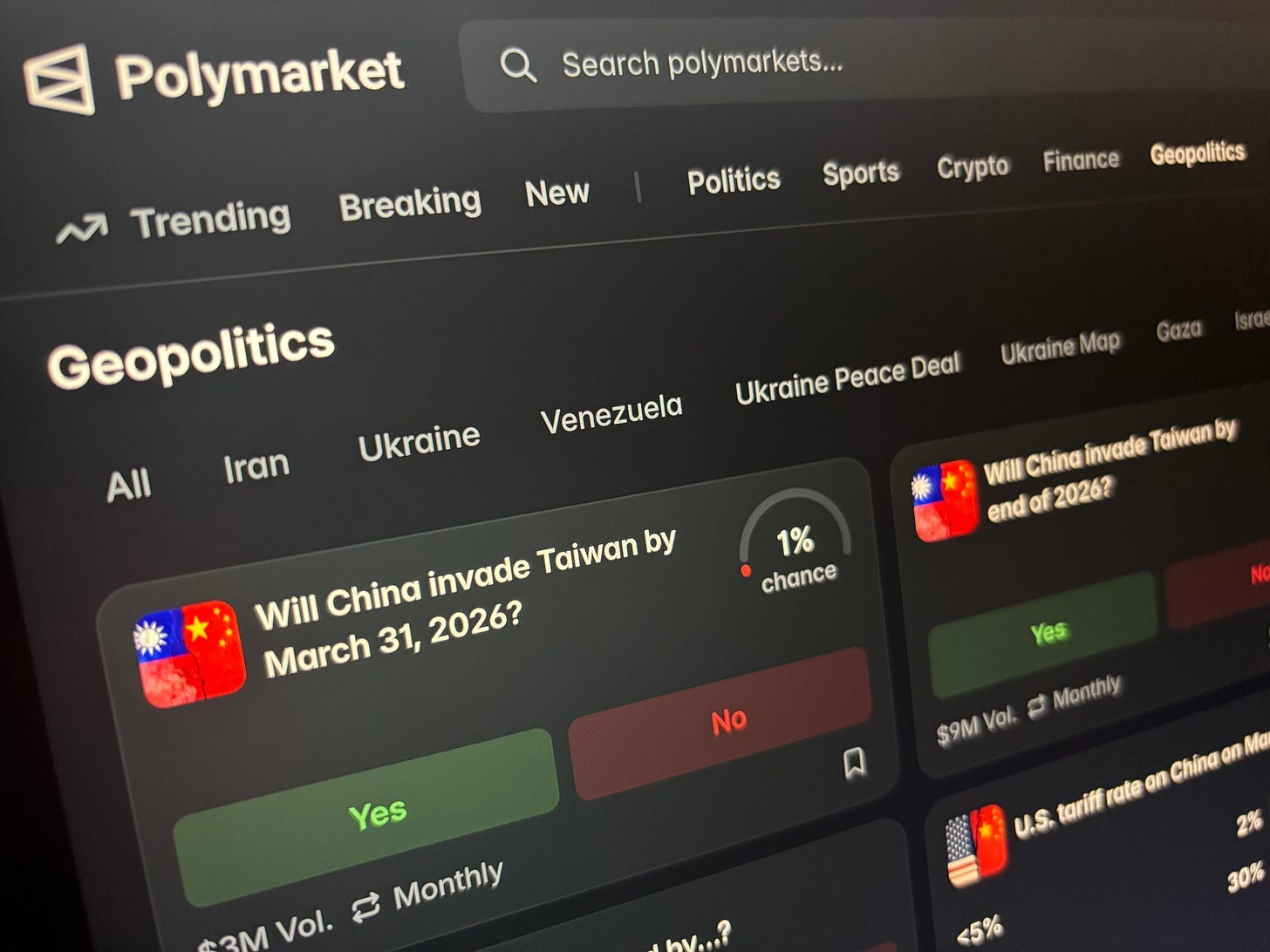
This piece was originally published in the ASPI Cyber & Tech Digest on Friday, 28 February. Apologies to subscribers who receive both. A quick update before you read: on the day it published, Polymarket saw $529 million in trading on Iran strike contracts, with six newly created wallets making roughly $1 million by betting on strikes hours before the first explosions in Tehran. OpenAI has since fired an employee for trading on Polymarket with confidential company information. Kalshi had two insider trading scandals of its own. The Associated Press announced a partnership with Kalshi ahead of the 2026 midterms. The case for cracking down on all of this is obvious. What follows is about why it’s also complicated.
Crypto prediction platform Polymarket is courting Chinese users. Beijing will not be pleased.
According to Justin Yang, who leads Polymarket’s go-to-market strategy in Asia, “China is becoming a very important geography for Polymarket.” The company is hiring Mandarin-speaking support staff, building a Chinese-language interface and tracking Chinese search trends to generate culturally relevant betting markets.
The problem: Polymarket runs on cryptocurrency, China bans both online gambling and crypto trading, and the platform is blocked by the Great Firewall. The company is expanding into a market where its core product is illegal, inaccessible and ideologically suspect. Its apparent bet is that Chinese users will use VPNs and bear the legal risk themselves, a familiar posture in the crypto industry.
Prediction markets allow users to buy and sell contracts on the outcomes of future events. Prices move in real time, offering continuously updated probability estimates. In recent years these platforms have grown rapidly, with hundreds of millions of dollars wagered weekly. Alongside sport and pop culture, they host markets on wars, elections, central bank decisions and geopolitical flashpoints such as whether the United States will strike Iran, how the Russia--Ukraine war will develop, and whether China will invade Taiwan. Media outlets increasingly cite their odds as real-time forecasting.
But there is a paradox. The features that make prediction markets alarming to governments -- anonymous trading, financial incentives for leaks, the ability to price rumour in real time -- are precisely the features that could make them unusually revealing about China. They threaten the party’s control of information at home while offering outsiders a rare window into one of the world’s most opaque political systems. That creates a genuine dilemma for Western regulators: how to constrain these platforms without inadvertently killing off the markets on Chinese politics that might, one day, tell us something important.
The security concerns are already concrete. US senators have proposed banning officials from trading on the platforms. Portugal has ordered Polymarket to shut down; Ukraine has banned it; and regulators in the Netherlands, Romania, France and Belgium have moved to block access and penalise operators. A market on whether Russia would capture the Ukrainian city of Myrnohrad generated over $1 million in trading volume; at one point, a live war map used to resolve bets was edited to show a false Russian advance -- a glimpse of how financial incentives can corrupt the underlying data.
The deeper problem is structural. Prediction markets reward those who obtain information before anyone else. That creates financial incentives to leak sensitive material, to act on privileged knowledge, or, as former White House ethics lawyer Richard Painter has warned, for insiders to shape the decisions they are betting on. In February this year, Israeli authorities charged a reservist and a civilian for wagering on military operations using classified information. A month earlier, a trader made roughly $400,000 betting that Venezuelan president Nicolás Maduro would be removed from power, shortly before a US operation captured him-- a trade analysts assessed as more likely than not based on insider knowledge. Suspicious betting spikes have also preceded major announcements, including the Nobel Peace Prize, a US government shutdown decision and a Trump--Zelenskyy meeting.
Polymarket’s CEO Shayne Coplan has embraced the logic openly, saying the platform creates incentives for people to “divulge information to the market.” For economic forecasting or Federal Reserve decisions, that argument has genuine appeal -- markets have a way of finding what people actually know. For national security, it describes a serious vulnerability.
All of this is already troubling for open democracies. For China, it would be explosive.
The Chinese Communist Party treats rumour as a political threat. Citizens are detained for spreading unapproved information, and the state devotes enormous resources to controlling narratives about the economy, public health and elite politics. Speculation about leadership succession, factional struggles or policy failure is especially sensitive, seen not merely as embarrassing but destabilising to a system built on the appearance of unity and certainty.
Prediction markets, by design, price rumour in public and in real time. Polymarket already hosts markets on whether Xi Jinping will divorce, which senior officials he might purge in 2026, whether a coup attempt will occur before 2027, and whether Zhang Youxia, the former Central Military Commission vice-chairman, will be sentenced to prison. Millions of dollars are being wagered on Chinese GDP figures, military clashes with Taiwan, Japan and the Philippines, and a US-China military confrontation. These are not theoretical possibilities. They are live markets, priced in real time, today. Meanwhile, Chinese users are sharing strategies on Xiaohongshu and building AI tools to track markets.
The ideological collision this represents is not subtle. The hard-right venture capitalist Peter Thiel once quipped that ‘Crypto is libertarian and AI is communist.’ China is proving him right.
Western policymakers are right to be wary of prediction markets. The insider trading risks are real, the national security vulnerabilities are real, and the regulatory pressure is justified. But the design of those constraints matters. A blunt ban that kills off markets on Chinese elite politics, military movements and economic data would eliminate something valuable: an open-source, financially incentivised signal about one of the world’s most opaque major powers that no government agency can easily replicate.
The case for constraining these markets is compelling. So is the case for being careful about what gets constrained.
These markets are easily manipulable and could just as easily serve as an revenue for state directed disinformation. Prediction gambling has become a moral rot in society.